STEP BY STEP. TOGETHER.
Everything you need
for your first dive.
You do not need experience, your own equipment or to know how long you can stay underwater. You are here to learn.
Without experience, it is easy to choose the wrong equipment. We recommend hiring first: the course covers what makes equipment suitable for freediving and how to choose it. Buying makes sense afterwards. If you already own equipment, bring it along.
First, understand what you are doing.
We introduce freediving principles, relaxation, equipment and equalisation. We explain why we do each thing as well.
Then, try it together.
In the water, we gradually practise movement, duck dives and working with a buddy. Everyone has their own pace and room for questions.
A foundation to build on.
Safety procedures and mutual supervision are part of the course from the start. Certification is awarded once you meet the SFA school's requirements.
We learn freediving with respect and under supervision. Never freedive alone.
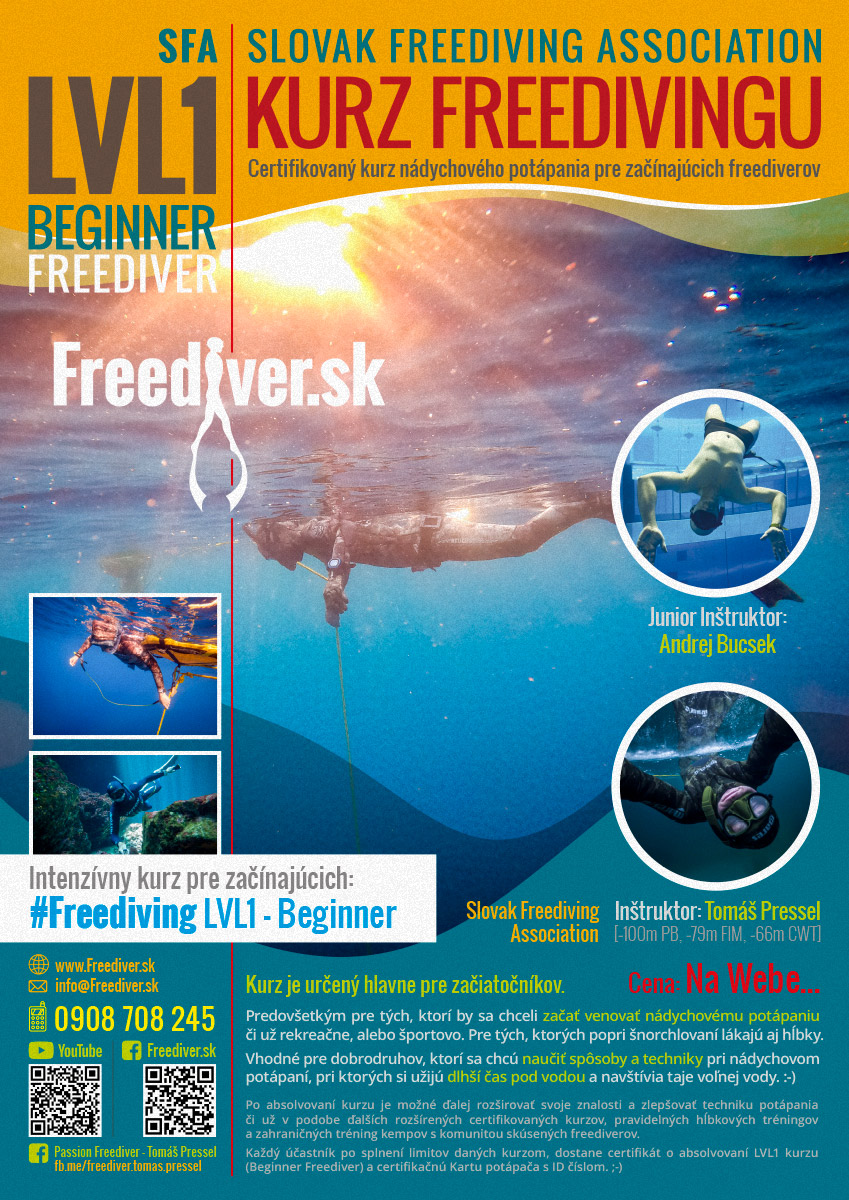 Enlarge poster
THE COURSE YOU ALREADY KNOW
The same foundation.
Explained more clearly.
We start with the basics and learn at our own pace. Details of both days, equipment and certification are below.
I would like to know more
Day one: preparation, theory and water.
We begin the morning with exercises and stretching for freediving. Under the instructor's guidance, we move on to breathing and relaxation exercises and dry static apnea. Between exercises, we cover the necessary theory.
After a break, a briefing is followed by the first static dives in the safe shallows beside the jetty. Everyone knows their role as both diver and safety buddy. We focus on correct execution, not times.
After rest and refreshments, we finish the theory and practise equalisation on land. Only when everyone knows what to expect do we move on to duck dives and depth diving. We end the day with a shared debrief on shore.
Day two: consolidating the basics and certification.
We begin with similar preparation to day one. Depending on progress, we continue with static apnea or devote more energy to depth dives. We review the necessary theory and take a knowledge test. We go through mistakes together and explain them.
In the water, we practise technique, equalisation and mutual supervision. You will also learn about FIM and CWT. Throughout the training, we use the buddy system and focus on safe dive execution.
The current SFA course description on the original website lists a depth of 12 metres and rescue practice from 10 metres among the LVL1 certification requirements. Surface procedures must be mastered before practice at depth. We never push anyone into performance; the next step comes only when they are ready.
After you meet the requirements, we award a certificate and diving card. These conditions refer to the existing SFA course description.
What do the two course days look like?
Both days start at around 9 am. The first day runs until late afternoon or evening, depending on fatigue and how everyone feels in the water. Day two is usually more relaxed, finishing around 2–3 pm. If there is still energy and enthusiasm, we may continue. You will receive precise practical instructions for your chosen date.
What if I find it difficult?
Every day is different and everyone learns differently. If something is not working, we do not push for performance. We help you understand why and agree the next steps. It does not mean you have not completed the course — you receive a diploma, can practise what needs work and return for re-certification. A good experience is not a reward for reaching a depth. Certification itself always depends on meeting the course requirements.
What should I bring?
Swimwear, a towel, drinking water and a mat or blanket for the shore. For diving, we use a mask, snorkel, fins, wetsuit and weight belt. Request anything you need from our hire service in the form. We do not recommend buying new equipment before the course without knowing what to look for. Hire it for LVL1 first; we will teach you to assess its suitability before you decide what to buy.
Do I need to take Intro first?
If you are starting as an individual, we recommend the two-day certified LVL1 course. You do not need Intro first. Intro is a one-day introduction without certification and can be an alternative for a group of friends.
Intro is available only on request for your own group of 4–6 people. You arrange the group yourselves. We do not collect individual Intro applicants or put groups together, and we do not publish Intro dates. A date is agreed after your group enquiry. Equipment rental is not included in Intro. We agree the date, venue, programme, course price and any equipment rental when handling your enquiry.
I can dive deep. Can I go straight to LVL2?
Depth alone does not replace basic training. LVL1 covers the theory, safety procedures and buddy skills on which later levels build. If you hold another school's certificate, contact us so we can check the requirements for further training.